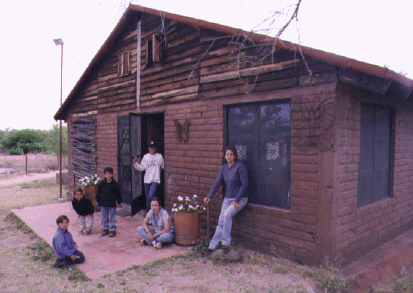
Students of various ages in front of the Study Center (our school at Los Horcones).
|
Students of various ages in front of the Study Center (our school at Los Horcones). |
SCHOOLING AT LOS HORCONES
In Los Horcones, school-age children receive certified academic instruction, from pre-school to high school, in the community.
We built a school building that we call "Study Center". The teachers (or instructors) are some of the community members who are knowledgeable in a particular subject and who have also learned (usually in the community) effective teaching techniques. Curriculum includes the assignments required by the Mexican department of education plus other courses added by the community such as English, Behavior Analysis, Ethics, Philosophy, Computers and a variety of technical courses. Students obtain their legal certification by taking exams in the city. Children from foreign countries continue their academic education by home schooling or open schools' programs aided by their parents.
Of course, when there is a growth in the population of the community and the number of school-age children increases, the organization of the area of education becomes more effective. For example in 1995 we had 20 students in elementary school.
The emphasis of academic instruction is made on teaching our students a love of learning, to be curious and enjoy learning instead of placing the importance on grades, certificate and degrees. Behavioral technology is applied to teach students to be reinforced by the natural consequences of the behaviors involved in studying and learning. In other words, we try to teach students to be intrinsically satisfied by studying instead of depending from praise, rewards, grades, gold stars, tokens, m&m's, degrees, given by teachers, parents peers. We consider these extrinsic or artificial reinforcers to be very useful in establishing the natural consequences of the behavior as natural reinforcers.
By the time Los Horcones grown up children finish their high school they have already taken some courses from college. Usually instead of choosing a single career, they choose courses from various careers which interest them and can be useful to the community. They often take courses without enrolling, just to learn, in this cases teachers usually welcome their interest. They see their studying as a continuous practice. However if some of them want to study a single career and obtain a degree they receive our support.
Our Personalizing-communitarian and behavioral educational model is fitted for a cooperative, egalitarian and pacifistic society where every member is important and where aversive control is avoided. We have been fortunate to have available an existent learning theory: the technology of teaching (Skinner 1954, 1968) and research and literature about the application of these to education (Keller & Ribes, 1974; Bijou, 1968; fester, 1968; Lindsley, 1971; Snelbecher, 1974; Becker, Englemann & Thomas 19975; Fraley & Vargas, 1976; Vargas, 1977; Sulzer-Azaroff & Mayer, 1977, 1986; Latham 1995).
Brief History of our educational practice.
We started teaching our children by applying behavioral principles to traditional group instruction. Nevertheless, many questions in relation to the ideal educational system for students living in a Walden Two remained unanswered. Some of these questions were: - How can our students learn more independently? How can we insure mastery in performance for each individual student? Which system offers not only more learning, but more satisfaction in learning? How can we reduce the teacher's work hours? How can we offer our students more flexible schedules? Which educational system does not promote competition among students? Many behaviorally based programs such as programmed instruction, precision teaching, direct instruction, PSI and computer assisted instruction proved to be effective and were implemented from the first years of Los Horcones.
The Personalized System of Instruction (PSI) (Keller, 1968) has been a very adequate system for the community. PSI has been adopted to teach most of the elementary and high school courses. In fact, in Los Horcones PSI was implemented for the first time at the elementary level. To Fred S. Keller, creator of this system, the application of PSI in Los Horcones has been the most extensive and effective . See Personalized System of Instruction at Los Horcones .
Insert here F.S. Keller's prologue to the book of PSI in Los Horcones Community.
For many years, members of Los Horcones have conducted research on academic instruction. We provide counseling, assessment and teacher training to schools and universities.
With the results obtained in our research on education, we developed our present educational model which has strong philosophical bases and embraces all behavioral teaching methods. We named it Personalizing-Communitarian and Behavioral educational model.
A BOOK ON EDUCATION
We just finished writing a book on education which we hope to see soon published in English. It is tentatively titled "Reflections for Teachers". We wrote it to encourage teachers to reflect on their teaching practices and to promote and analysis of education as a cultural practice. Although it is a highly philosophical book it includes many practical suggestions. The main underlying assumption of this book is that it is possible improve our educational system by changing -improving-ourselves as teachers, despite the often adverse conditions in which we teach.
Most frequent questions about schooling:
1. Do children who study at Los Horcones obtain legal certification of their studies?
Yes.
2. What happens when grown up children finish their studies in the community and want to study outside?
The community pays the expenses of any son or daughter of a permanent member. Visitors and newcomers would have to cover the expenses of children who are studying outside.
Last up-date: 2001
Go back to the Index.