PSI
The Personalized System of Instruction
This educational method, better known as PSI, was developed by Fred S. Keller and associates in 1963. PSI has five essential components which are: an emphasis on the written word, unit mastery, self-pacing, student proctors and the use of lectures and demonstrations.
Experimental research conducted on the use of PSI involving small single classes and entire academic departments and institutions gives evidence of the teaching effectiveness of this system (Journal of Personalized System of Instruction, 1977-79; Sherman, Ruskin & Semb, 1974, 1982, Johnston...).
PSI IMPLEMENTED AT LOS HORCONES
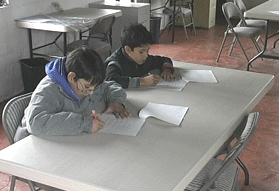
In Los Horcones, we built a small school which we call "Study Center". There, the children and teen-aged youths living in Los Horcones take elementary and junior high school level courses representative of PSI.
INSTRUCTORS: In this study center, the instructors (teachers) are community members who have had previous training in behavior analysis and its applications to education. It is opportune to say that the community has given instructors the work time needed to support such an educational venture. The main responsibilities of instructors are: a) To select all the study material used in the course. b) To present this material in the form of written study units, study questionnaires, and evaluation tests. c) To evaluate students' progress. d) To provide for the students lectures, demonstrations and discussion opportunities.
WRITTEN STUDY MATERIAL: The study material for each course is available to the student in written form. The material for each course is divided into a series of small units that are to be studied sequentially. Each course consists of about 60 to 100 study units. Instructors take approximately an hour to write one study unit. The material is written by hand or typed using carbon paper for copies and oftentimes we use a computer. Instructors always save the original units to form a "textbook." Even though a large amount of time is actually invested in writing the study material, it will be compensated by its subsequent usage. In future uses, only minutes will be needed for the instructor to make some corrections or improvements. Students have free access to these written study materials which is placed in a file cabinet at the study center . The units for each of the courses are kept in a folder marked with the corresponding number. In the same cabinet, in another drawer, students keep folders with their names on them for each course they take. There, they save the completed study units in case they want to review them.
STUDY UNITS: A single study unit is composed of three parts, these are: 1) The study material. It is a page or two containing a clear exposition of the concepts that are to be learned. It also includes some critical information from the preceding unit. Students can go over the study material as many times as they need to master it. 2) The study questionnaire (readiness test). It is a page attached to the study material containing questions, items and problems related to the study material. Students are taught to use this questionnaire to self-evaluate their mastery by checking their answers in the study questionnaire with the information included in the study material. 3) The evaluation questionnaire (mastery test). This is another page of problems related to the activities that the students completed to learn the skill taught in the unit. This page is not attached to the others, but it is given by the instructor when the student asks for it. Evaluation questionnaires can be oral, written, or both. In most cases, the written evaluations are followed by oral questions. The study material also includes review units and retention tests.
MASTERY CRITERION: Before advancing to the nest study unit, the student must meet a mastery criterion of 95 to 100% of correct responses. We selected a high criterion based on the studies of Johnston and O'Neill, who demonstrated the functional relation between the mastery criteria asked and student performance (Johnston & O'Neill, 1973).
PROGRESS CHARTS: At Los Horcones, when implementing a personalized system of instruction, we don't need to keep the traditional grading system. Instead, students keep a progress chart in each of the courses they take. They record their success on the chart by graphing the number of units completed per day or per week (see pictures 11 and 12). With a mastery criterion and retesting, students never fail and their progress through the course is shown by the ascending line on their chart. the students report that it is reinforcing for them to see the ascending line closer to the top. No "social pressure" by peers or instructors is put upon the students who progress slower than others. Nor do advanced students obtain "social prestige" or privileges for progressing faster than the rest. They are taught to see their progress as a self-competition, rather than as a form of competing with their peers.
At Los Horcones, students obtain their legal certificates by passing examinations at a public school in a nearby town. Their performance has always been very good. Our study center is not yet accredited. Accreditation would require us to make some non-rational changes in the educational environment as, for example, filling many bureaucratic requirements.
SOME RESULTS AND APPRECIATIONS
el Following we chare with you some results and appreciations obtained by comparing PSI at Los Horcones with the previos traditional lecture system we used. These conclusions are based on our recors since we started implementing PSI.
- The percentage of correct responses in tests (study and evaluation tests) is 100%.
- Students performance improved about 50%.
- All students complete more units per week than the required.
- There is not a functional relationship between the number of questions or exercises included in the study and evaluation questionnaire and the percentage of correct responses.
- Initially, students had a high rate of asking for more than the required study units. Unfortunately, their behavior decreased because instructors did not have enough extra units available. Now that instructors are getting expertise in writing the material and have more units available for them, the students behavior of asking for more units to complete is increasing.
Some subjective appreciations from instructors and students:
- An increase of smiles and approval in both students and teachers is observed.
- An increase of students study-related behaviors outside their academic responsibilities. For example, reading books and asking questions.
- A reduction on students complaints about studying and study schedules.
- An increase in discipline. Students reported obtaining more satisfaction while learning.
- Instructors report more satisfaction in teaching.
- An increase in the personal relationships between instructors and students is observed.
- Instructors report satisfaction with the opportunity to improve their skills by the immediate feedback received from students.
If you are more interested about this subject you can read our comments about: Implications of the use of PSI in a Walden Two community.
Last up-dated: 2001
Go back to the Index.