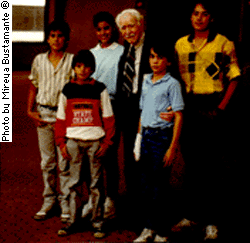
Fred S. Keller with some children from Los Horcones community: Juan, Mireya, Javier, Amín and Esteban.
Keller, besides being a great educator, was a very loving and affectionate man.
Fred S. Keller
1899- 1996
|
Fred S. Keller with some children from Los Horcones community: Juan, Mireya, Javier, Amín and Esteban. Keller, besides being a great educator, was a very loving and affectionate man. |
Fred Simmons Keller, was a remarkable educator. He was born Jan. 2, 1899, on a farm near Rural Grove, N.Y. and discouraged, left school at an early age to become a Western Union telegrapher. He enlisted in the U.S. Army during World War I and served with the American Expeditionary Force on an ammunition train, attaining the rank of sergeant.
Keller was a Harvard classmate and lifelong friend of the behavioral psychologist B. F. Skinner and was, with him, among the first American proponents of behaviorism, which emphasizes the role of environmental events in the shaping of human behavior. Skinner dedicated his book "Science and Human Behavior" (1953) and "The Shaping of a Behaviorist" (1979), to Keller.
He earned a B.S. from Tufts in 1926 and an M.A. in 1928 and Ph.D. in 1931, both in psychology, from Harvard. Keller taught at Colgate from 1931 to 1938 and joined the Columbia faculty as an instructor of psychology in 1938 where he taught for 26 yrs. He was named assistant professor in 1942, associate professor in 1946 and professor of psychology in 1950. He served as chairman of the department from 1959 to 1962 and became professor emeritus of psychology in 1964.
The path-breaking psychologist gave his name to the Keller Plan, also known as the Personalized System of Instruction (PSI), an individually paced, mastery-oriented teaching method that has had a significant impact on college-level science education. Though other proponents of self-paced education had tested some of its elements in primary and secondary schools, Professor Keller brought all elements of the plan to the college level. With the publication of his paper "Good-bye, Teacher!" in 1968, the Keller plan received national recognition and college instructors began to experiment with it. Students have responded positively to the plan, and, in published studies, their final examination performance equals and usually exceeds performance in lecture sessions. After retiring from Columbia in 1964, Keller went to the University of Brasilia in Brazil, where he helped found the psychology department and offered the first course using his personalized instruction method. Students received a printed study guide for the first unit of the course and could work anywhere--including the classroom--to achieve the objectives it outlined.
In the early 1940's, based on his research in behavior, he developed the "code-voice method", a new technique for teaching Morse Code to radio operators and military personnel. Rather than dictating long bursts of code to students, instructors using his method told students after each signal whether they had correctly decoded it. That approach gave students instant feedback, allowed them to correct mistakes immediately and was far more effective in teaching the code than previous methods. The U.S. Army Signal Corps adopted officially in 1943. In 1948 Keller received the Certificate of Merit from President Truman for the Morse Code work, and he used the method to teach the code to Columbia College undergraduates preparing for military service.
In 1947 Keller, with his colleague William Schoenfeld, instituted at Columbia College the first undergraduate psychology course to use Skinner's experimental methods. Students taught white laboratory rats to respond to stimuli through rewards. In one experiment, rats received a pellet of food only if they pressed a bar when a light was on; they soon stopped pressing the bar when the light was off. The point of the experiments was to demonstrate the idea that broad principles of behavior could be discovered experimentally, and that such principles had important applications to human society. Many colleges now offer courses in experimental psychology using laboratory animals.
Keller and Schoenfeld assembled much of what was known about behavioral psychology in the widely used textbook "Principles of Psychology" (1950). Behavior theory held tremendous potential to help educate people better, the two authors believed. They wrote in their conclusion: "We are on the frontier of an enormous power: the power to manipulate our own behavior scientifically, deliberately, rationally. How this power will be used--whether for good or ill--no one of us can tell."
Fred S. Keller was a Fellow of the American Psychological Association and a past president of the Eastern Psychological Association. He received the Distinguished Teaching Award from the American Psychological Foundation in 1970.
Fred S. Keller died at 97 yrs. on Feb. 2, 1996, at his home in Chapel Hill, N.C. (U.S.A.). He is survived by his wife of 60 years, Frances Scholl; a daughter, Anne S. Cline of Kalamazoo, Mich.; a son, John V. Keller (CC '64) of Charlotte, N.C.; five grandchildren and one great-grandchild.
|
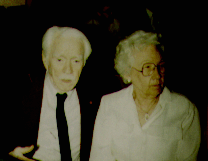
Fred S. Keller and his wife Frances. |
Books written by Fred S. Keller:
Keller, F. S. & Sherman, J. G. (1974). The Keller Plan Handbook. Menlo Park, CA: W. A. Benjamin Co.
Keller, F. S. & Sherman, J. G. (1982) The PSI Handbook: Essays on Personalized Instruction. Lawrence, KS: TRI Publications.
"Principles of Psychology," (1937, an early text).
"The Definition of Psychology" (1973);
"Collected Writings, "(1934-1950);
"Learning Reinforcement Theory" (1954, 1969).
Relationship of Fred S. Keller with Los Horcones:
under construction
Last up-date: 2001
Go back to the Index.