Walden-Communitarian Family
"Our goal is to have every adult member of Walden Two regard all our children as his own, and to have every child think of every adult as his parent."
B. F. Skinner, 1948, Walden Two, p.32.
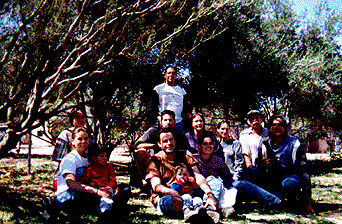
We call our family structure: "Walden Communitarian family*". This type of family is formed by all community members independently from having or not consanguine Al or kinship ties.
All adult members share the compromise of loving, caring for and educating like our own, all the children who are part of the communitarian family. It has been demonstrated that not only parent or relatives of a child have an important influence in their education but also all those people who are a part of his/her life.
In a walden communitarian family, monogamy is respected and couple relationships are committed and stable.
A walden communitarian family does not abolishes family, it rather extends it to more people to form a more humanitarian family.
* At the beginning of the community we called our family structure, extended or open family. But because there is already a classification of extended family within the field of anthropology and sociology which does not fit our type of family. An extended family only includes grandparents, uncles and other relatives while the communitarian family includes as family members people who are not biologically related.
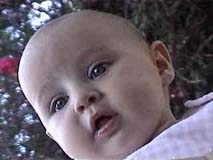
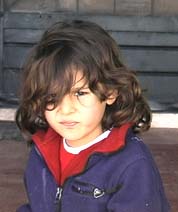
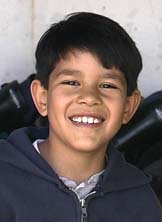
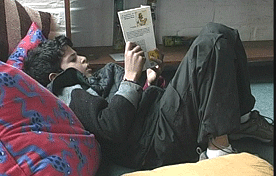
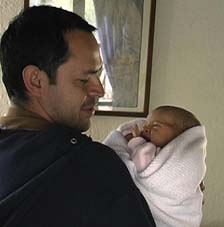
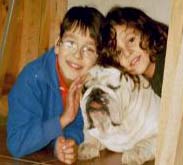
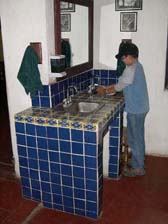
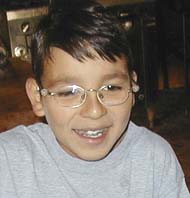
Presently, (January 2002) our communitarian family is formed by all adult members6 of whom were born here. Alejandra an adolescent girl and 4 boys: Emmanuel, Daniel, Abraham and Andrés. A baby girl is expected for Februaary 2002.
|
|
Diana Melissa born February 1st. 2002 |
Andrés 6 años |
|
|
Abraham, 6 años |
Daniel, 9 años |
 |
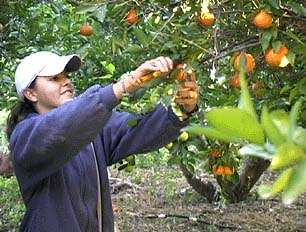 |
| Emmanuel, 11 años | Alejandra de 15 años es parte de nuestra familia comunitaria, sin embargo, es una adolescente independiente y responsable. Ella ya no vive en casa niños, tiene su cuarto privado junto a la casa niños y generalmente es considerada más como un miembro adulto. |
"Our goal is to have every adult member of Walden Two regard all our children as his own, and to have every child think of every adult as his parent."
B. F. Skinner, 1948, Walden Two, p.32.
Characteristics of a communitarian family.
Its main characteristics are:
1. It is behaviorally designed.
Communitarian family was designed based on data derived from the science of behavior. It applies behavioral principles to shape and maintain communitarian family behaviors.
2. It is communitarian (open).
It is formed by all members of the community regardless of conjugal ties or kinship. We see each other as part of one large family. We love, take care and educate all children regardless of having or not a biological relationship with them. Adult members share parenting functions.
Every adult member is considered a behavioral parent.
We coined the term "behavioral parents" to denote the parenting function all the adults who live in Los Horcones have, regardless of being biologically related to the children or not.
Since all members of Los Horcones influence the children's behavior, we are all behavioral parents.
The fact that all adults influence children's behavior is not something that happens exclusively in the community. It happens everywhere, children learn a lot from people other than their biological parents. They learn from their relatives, teachers, neighbors and even more distant people like heroes, T.V stars, etc.
Children learn by imitation everywhere, they also learn as a result of the ways we respond to them . We reinforce their behavior, extinguish or punish it in our daily interaction with them. See Glossary .
*The terms "behavioral parents" or " biological parents" are not used by children to address parents, nor by the members to address each other, we always use our names. We use these terms to explain the concepts according to which we live.
Within a communitarian family, all adult members of the community are educated for parenting. There are members in charge of teaching the rest of us how to apply behavioral principles to child education.
3. It is egalitarian.
All children are equally treated whether they are our biological children or not.
4. It is cooperative.
All members cooperate in taking care of and educating the children.
5. It is pacifist (non-violence).
It promotes peaceful personal relations.
Some advantages a communitarian family has for the society:
- There are no orphans, neglected, abandoned or abused children.
- There are no neglected, abandoned or abused elderly.
- Couples who are unable to procreate or those
who want to remain single can have and enjoy parent-child relationships
with the children.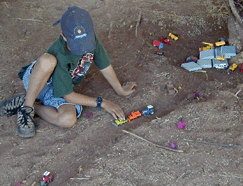
Some advantages of a communitarian family for
children: 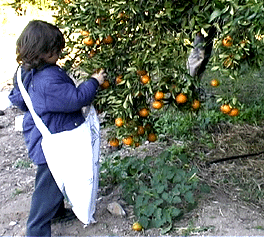
- They receive more love, care and attention from more people.
- Educational and recreational activities appropriate for children as well as the company of other children and adults are always available for all children.
- The fact that the communitarian family requires parents to learn about child care and education, prevents the many problems children have when they are solely in hands of parents who are careless or ignorant about child education.
- They are always cared by fathers, mothers or older brother or sisters(biological and behavioral) who can devote child-care time exclusively to that activity without having to tend other household or business chores.Since those who take care of the children are not busy or tense, they are able to enjoy child care, be creative and give children quality time most of the time.
- Since they are little, boys and girls who are raised in Los Horcones,observe that men and women equally participate in child care and learn from them.
- For children all the community is their home and all the members are their relatives. They can go around the community safely, without the risks many children find outside of their homes today and that confine them to their home or restrict many of their possible activities.
- Children grow up in a healthier, more natural and less problematic environment than most children in nuclear families.
Some advantages of a communitarian family to parents:
- Child care is valued (and paid within the community) as any other income producing work. The community not only expects mothers and fathers to take care of children but give them the necessary time. All members devote a few hours of child care per week and in this way all can have leisure time.
- Parents (except those who are jealous and see their children as possessions)are happy to see children being loved by and learn from a lot of people who they know and in whom they can trust.
- Sharing with others the many responsibilities involved in raising and educating children, reduces the load for parents.
- Parents can be tranquil enough to do other activities while their children are taken care of by those who share their ideals, educational objectives and respond to the children in ways similar to how they would respond. Parents also are more tranquil when they know that children are taken care of by people who are prepared and enjoy being with the children (who are not merely working for pay).
- Women, who traditionally take almost full care of their children, in a communitarian family share this activity with men.
- Single parents are not alone in their task of taking care and educating children.
- The problem that currently face many working parents of caring for their sick children without risking or loosing their jobs, does not exist in a Communitarian family.
- Another problem adult people currently face, specially women, the responsibility of taking care of their old or sick parents is reduced in a communitarian family where all members share this responsibility.
List of behavioral objectives for children
In Los Horcones, we have a list of what we want and do not want children to learn. We call it "List of Behavioral Objectives for Children". It objectively describes those behaviors we consider important for children to learn in order to grow and develop as happy, responsible,communitarian individuals. For example, cooperation, equality, sharing,pacifism, altruism, responsibility, participation in decisions, mutual help,creativity, and many more. Behavioral procedures derived from the science of behavior are consistently applied to achieve these goals.
We do not leave the learning to communitarian values to the passing of time. We rather provide or arrange the conditions so we can learn to behave communitarianly. Communitarian values need to be taught,not just expect them to happen. There is not a better way to teach them than providing a whole society based on their practice. For example, Western culture speaks about promoting non-violence (pacifistic) values but, in general, it promotes violence and aggression.
|
 |
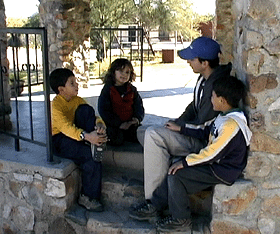
Communal or communitarian child care system.
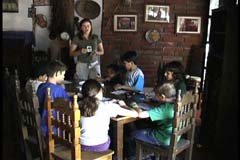
The children who are part of the communitarian family (sons and daughters of community members) are taken care of communally by their behavioral parents among which are included their biological parents. This means that children are not raised within a nuclear family and cared for only by their parents.
Children are grouped according to their age. One or more adults take care of a group of children. Sometimes, when there are many children, various groups get together for a particular activity like a pic-nic,forming a large group of children of different ages.
Individual child care also exist, children are not only cared for in group. There are periods of time destined to the individual care of a child by an adult. It is common that members invite a child to accompany them while they work like when they go and feed animals, fix a door, make a cake, etc.
Only community members are in charge of child care activities.Visitors and soliciting members can participate in communal child care together with a member.
All community members attend classes on child care and education to be better prepared to help in the proper physical, biological and behavioral (psychological) development of the children. All members interact with the children, maybe some more than others but it is all of us who take care of and educate them.
We have a child care schedule that covers day and night.It specifies who is in charge of whom at a particular time. It also specifies the type of activities during the day.
We refer to the care takers as "Metas" which is an abbreviation of the Hebrew word "metaplot" which means child care taker. We adopted this term from the Israeli communities called Kibbutzim(better known as Kibbutz) where communal child care was a tradition. Here we need to clarify that the child care system of Los Horcones is different from that in the Kibbutzim in relation to the educational approach in which it is based.
The fact that within a communitarian family, child care is communal, does not imply that biological parents or other members are in some way restricted to be with the children whenever they want to. On the contrary, community life and our work system provides the ideal conditions for parents to be with the children often. Having a communal child care schedule, helps to know who is responsible for which children anytime.
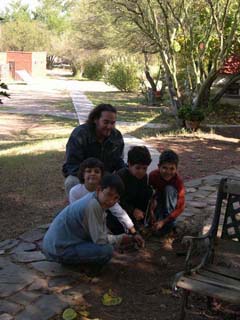
Communal child care has been successfully implemented from the beginning of Los Horcones 25 years ago. Children live happy and grow healthy (without "complexes" or "frustrations"). We're currently raising the second generation of kids, our grandchildren.
 |
 |
Some of the advantages communal child care have for children are:
- There is a parent (or a grown up sibling) caring for them. They, besides having a close relationship with each child, are people prepared for their care and education.
- There are other children their age to play with.
- There are many educational and recreational activities for them, appropriate for their development according to their age.
- Metas (child care-takers) have the time exclusively for the children,they do not need to do other household chores incompatible with playing with the children). Children receive quality attention.
- Metas have studied how to apply behavior principles to child behavior management.
- Children have contact with other adults than their biological parents with whom they gradually establish parent-child relationships.
- It encourages children to treat each other as siblings, share toys and clothes.
- Children have more models, more people who behave in communitarian ways, to imitate, this is, from whom to learn.
- Since all adults agree on which behaviors to encourage in the children and which not, the ways how adults respond to their communitarian and non-communitarian behaviors is quite homogeneous. This helps children to learn faster and with less conflict than when parents respond differently because there is no agreement.
 Some of the advantages communal child care have for parents
(behavioral and biological) are:
Some of the advantages communal child care have for parents
(behavioral and biological) are:
- Children are always cared by adults who share the communitarian ideals and educational objectives for the children.
- Metas establish a parent-child relationship, not like in a day care.
- Communal child care allow parents to devote time to other activities while living their children in hands of people they trust.
- Parents can be with the children anytime, or merely pass by the children's house and observe activities that are going on and if they want to stay and participate. They do not have to wait for a certain time to be with them.
- Parents can go to the city or travel knowing the children stay where they live and with people they trust, without resenting the temporary separation.
The Children's House
 |
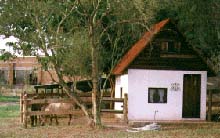 |
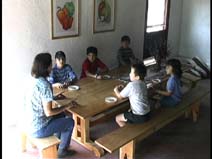
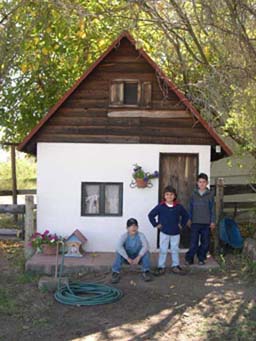
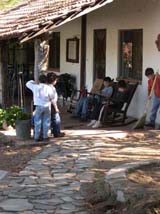
At Los Horcones, children live together in a children's house. There, they are cared for communally (during day and night) by biological and behavioral parents. Having communal child care does not mean that parents are restrained from being with their children, on the contrary, parents can be with them any time. The community has had a successful communal child care program from its beginning.
Note. Presently, there are only 4 children living in this house, sharing toys and clothes.
Members study to become behavioral parents.
Any member can participate in communal child care after learning about child care and education. Every member has the opportunity to learn to apply behavior principles to child education.
We need to learn to be good fathers and mothers, we are not born knowing it.
Frequently asked questions about family in Los Horcones
1. Are parents forced to have their children living at the children's house and under the care of other members?
No, like all our communal practices, they are implemented by conviction not by coercion. Children join only when parents are convinced of the advantages it brings them and their children and when both feel comfortable in doing so. This applies especially to newcomers.
2. Are parents forced to leave their children in the children's house at night?
No. But our experience has shown that eventually all parents end up allowing their children to live there. Parents can sleep with the many time at the children's house.
3. Who take care of newborns and where do they live?
Children born to community members are taken care by their biological parents and other members. They live in the childrens'house where there is a nursery. Their biological parents also live there usually until the children do not need to be breast fed at night, or until the biological parents decide to move to their private room.
Babies born to new members or newcomers usually live in their parents' private room until the baby does not need to be breast fed.However, biological parents are not forced in this aspect. They decided together with the rest of the members.
4. Do the children of visitors live in the children´s house?
No, except after making friends with the community they are invited to spend the night.
5. What happen with the children of families who join?
They live with their parents initially and are taken care by them. Children and their parents gradually join communal child care. Once children are familiar with the members involved in communal child care they join full time. Their parents become care-takers and participate in communal child care part of the day.
6. What happen with children who are born to community members?
They are raised communally since newborns.The biological parents move to the children's house (where there is a nursery)the first months, until the baby does not need to be breast fed at night.Babies spend most of their time with their biological parents, especially with the mother. However, other community members start to establish a relationship with babies from the first days, holding them, talking to them, changing their diapers, bathing them, giving them tea or juice, etc. In this way,we rapidly become part of the baby's family.
7. What happen with children who are born to new members?
Usually, a crib is placed in their private rooms where they keep them the first months. Members also try to establish a relationship with the baby, however it is not so close, because parents-specially mothers- do not welcome it. This usually changes when the baby's parents -specially the mother- become better acquainted with the members and the community, understands better the communitarian family and grow tired of being responsible for all the tasks related with raising the baby 24 hours a day. When this happens they rapidly see the advantages of communal child care.
8. Do children stay all day in the children's house?
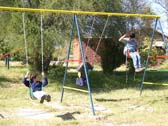
No. They usually spend only part of the day inside. They have activities on their schedule that are done in various parts of the community. One can spot them with the animals, in the garden,on the swings, in the shop, school, dinning room, etc. The children´s house is their base.
9. Do all the parents like to share their children´s love with community members?
Members do. We do not consider our children or their love as a possession. We like to see our children being loved by more people than ourselves. We know the rest of the members well and trust them.
Sometimes newcomers are reluctant to accept the idea that their children could love and could be loved by other people,but after some time they overcome it or they decide to leave.
10. If children are raised in a cooperative,pacifist, sharing and egalitarian environment, can they be shocked when they have to face the rest of the world?
Children raised in the community are not isolated and although they grow up in a different environment, than those who live outside the community, they become familiarized early and acknowledge the differences. Of course for them many aspects of Western Culture are strange. But no one has suffered a "shock".
11. Do the children who live at Los Horcones live isolated from society at large? Do they live in a crystal dome?
The children who live in the community are not isolated from the dominant culture or society. A Walden Two community will never be isolated because it is precisely an alternative made for it. Also to the extent the community grows it can offer more and better services and help to people who do not live here.
Our children have friends outside of the community. They travel often with us. Our children enjoy things children from the Western culture have such as bicycles, motorcycles, t.v., dolls, fashion clothes,music, etc. We only replace these things when we have a better alternative.We do not want to raise children who are "strange" and "different"to the children who do not live in the community, because of superficial issues. Instead we focus on teaching them to enjoy cooperating, getting along well with others and respecting them.
Sometimes the community is criticized by visitors who say our children are not too different from children raised outside the community.Unfortunately, they only look at the superficial (how they look, how familiarized they seem to be with places other than the community), without analyzing the fact that our children have also learned other likes. For example they have learn to cooperate instead to compete, share instead of appropriating their own things, etc.
12. Are grown up children expected to marry only community members?
No.
13. Are grown up children expected to live in the community forever?
No. They can decide where to live any time and we will support their decision.
14. Where do they go to school?
We have a school in the community. However, presently due to the scarcity of members in the community, two of our children are attending three days per week, to a school in Hermosillo which has similar values to our school. Please see Schooling.
15. Do members share spouses?
No. Sexual relationships are private matters.Friendship is promoted among all members men and women of all ages. It is not communitarian to see other people as sexual objects. Couple relationships which do not involve commitment, are discouraged.
Note:
If you have children and want to join Los Horcones, we welcome you. But please deeply reflect what you will do because we frequently have people who come to live here with their children and as soon as we educate them,parents leave with them.
| If you mention what you have read on this page, please cite Los Horcones. You help disseminate information about this Walden Two community. |
Last up-date: December, 2002
Go back to the Index.