-- ECOLOGY --
| |
|
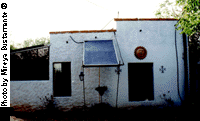 |
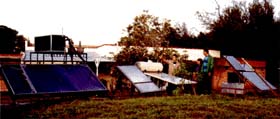
Solar water heaters used to heat the water in the laundry building and bathrooms. |
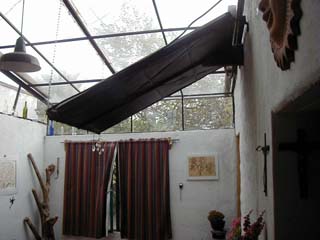
A solar water heater installed in a private room (bedroom) to heat the water in the bathroom which also has a transparent partial roof to heat the room. |
"A few highly industrialized nations cannot long continue to face the rest of the world while consuming and polluting the environment as they do."
B. F. Skinner, 1948
Human behavior is the product of our interaction with our environment (social or not social). We were not born destructive or constructive;with or without an "ecological conscience or awareness." We were not born with or without a love and respect for the environment. We learn to take care of our planet and the species that inhabit the planet. We also learn to destroy it or to neglect it. All the above statements represent a behavioristic approach to environmental problems.
The total environment where we live, this is to say, the environment that influences us to behave (act) the way we do, is the culture,the "Western Culture."
The origin of our ecological problems is in the practices of Western Culture. Many of its practices are anti-ecological. For example:the western concept of progress is based on economic development (having more material goods) and not in the psychological or human development of people (becoming better people, learning to get along with each other, help each other).
"Neither happiness or the survival of the group depends on the satisfaction derived from having things."
B. F. Skinner, 1978, p.47.
Competition, appropriation and consumerism are values promoted by Western Culture. We learned to consume more than what is reasonable.Each one of us wants to have his/her own house, car, television, land, etc.This practice almost always requires a negative ecological impact.
Western Cultural values generate ecological problems.
A culture that promotes sharing and cooperation would solve many of our ecological problems. If we learn to share, we could have less things. If we share we buy less. If we learn that progress is not having more but becoming more, we will solve many of our ecological problems.
A Walden Two community like Los Horcones is based on pro-ecological values.
Ecological problems are behavior problems.
Solving ecological problems
If we want to solve ecological problems we need to consider them as a product of human behavior. We need to analyze these behavior sand find the variables that maintain them.
Ecological problems are solved when the cultural practices that maintain them are changed.
Ecological problems will not be solved just by organizing meetings or conventions where we talk about them. To talk about problems is different from doing something to solve them. We need to change radically our culture, our way of life, our society.
Radical changes
Without making a cultural or social change, most pro-ecological proposals will remain as agreements or treaties. In order to go beyond,it is necessary to change the cultural practices. In order to have a cleaner planet, we need to act ecologically not only to plan to do it or to talk about it.
It is said that science and technology has produced the ecological problems we now suffer. We think it was not science or technology,but the inappropriate ways in which we have used them. Thus, science and technology can be appropriately used to solve ecological problems. An appropriate application of the science of behavior is fundamental. See Science of Behavior
---Verbal Pollution---
When we do not back up what we say or preach with our actions,we contribute with a special kind of environmental problem: verbal pollution.From our point of view, verbal pollution is one of the most relevant ecological problems -and one of the most ignored by ecologists.
We often think if only 1 % of those who want to take care of their environment lived in communities like Los Horcones, there would already be a number of communities around the world which would be clear examples that it is possible to live satisfactorily without having to harm or destroy our environment.
We invite ecologists to live here and help us to start from the very beginning an ecological culture. We invite you to go from verbal ecological concern to action.
Ecology Area at Los Horcones
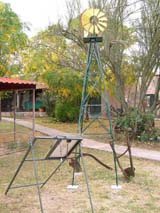
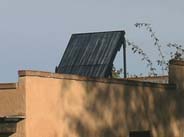
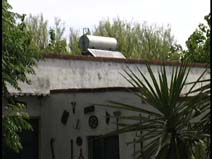
This part is under construction. It will include a description of the ecology area in the community. The ecological projects and programs implemented in Los Horcones. (Solar power projects, recycling, reusing,organic gardening, straw bale construction, etc.).
|
|
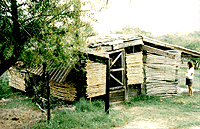
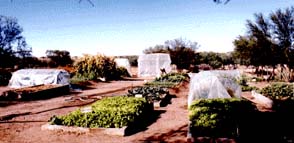
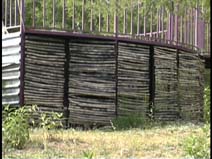
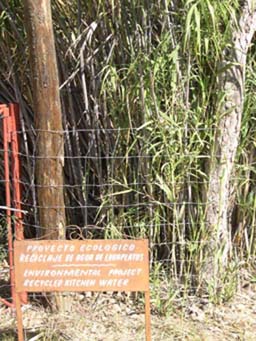
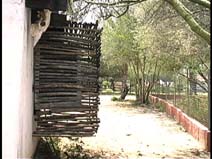
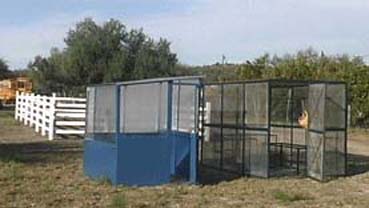
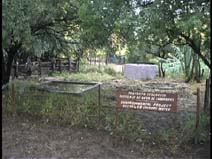
| We use bamboo curtains to provide shade in our buildings, in this case,the rabbit hutch. We grow the bamboo in Los Horcones and irrigate it using filtered gray waters from the kitchen sink. | Organic Garden |
 |
 |
 |
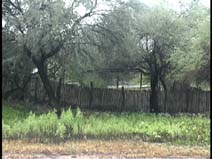
Note. Please do not expect Los Horcones to be an ideal community ecologically speaking. We are not as ecological as we would like to be. The scarcity of members leave us little time for ecological projects. We wait for your help to demonstrate that it is possible to design a sustainable society.Please come to help us.
 |
 |
 |
 |
 |
 |
Desert Tortoise Refuge
Los Horcones has a small reserve for a desert species nearing extinction. We have started with the desert tortoise. We want to preserve them. See Desert Tortoise Refuge.
Please do not expect Los Horcones to be a totally ecologically functioning community. We still have many things we need to change. We are waiting for people to help us to become a more ecological community. If you want to come to help us to build an ecological project, please write to us.
"Scientists should also be best able to say what can be done. The physical and biological sciences are needed if we are to redesign our cities... Unfortunately physical and biological technology alone cannot guaranty that its solutions will be put into effect. To solve the major problem we need an effective technology of behavior. We need,in short, a new field of specialization-the design of cultural practices."
B. F. Skinner, 1978, p.29
Last up-date: December, 2002.
Go back to the Index.