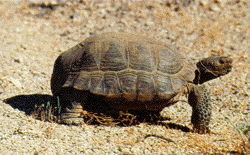
Desert Tortoise Refuge
in Los Horcones Community.
Desert Tortoise (Gopherus agassizii) Size: Length up to37 cm. Weight: 3-7 kg. Habitat: Mojave and Sonoran deserts in USA and Mexico. Surviving number: Unknown, currently in sharp decline.
We have a desert tortoise refuge in Los Horcones. Thesis one of the ways in which Walden Two can contribute to the preservation of our ecosystems.
We initially fenced a citrus orchard and kept the tortoises that we and our neighbors found. Some people who heard we were keeping them, brought more. Because we had problems with the orchard area, we moved the tortoises to a new space with a better fence.
-Insert here a picture of the new tortoise refuge.
We are going to let the tortoises reproduce in that place and once their young ones grow up, place them in another area where humans cannot easily find them.
You can help us to keep these tortoises and make a larger refuge. We welcome donations to this project.
If you know a person, foundation,or association which may finance this type of project, please let us know about it.
Ecological problems are human behavior products. Our ecological problems are not solve just for the science of ecology, but mainly by the science of behavior. |
Information about the desert tortoise.
The following description was taken from Joe Watts: watts@curly.tea.army.mail
Desert Tortoise (Gopherus agassizii), is a threatened species. Populations have declined recently in many areas due to two main human attributable reasons: the direct loss of individuals and habitat degradation / fragmentation.Individual tortoises are lost due to poaching, collection for pets, military activities, vehicular impact, livestock trampling, disease and raven encroachment.Habitat degradation and fragmentation occur mainly through the spread of urban sprawl and livestock grazing practices. In addition to a recent encroachment by ravens due to the presence of garbage dumps, desert tortoises also face the threat of a deadly upper respiratory disease in the Western Mojave area.
Habitat Characteristics
Desert tortoises are found on flats, alluvial fans, downhills and rocky terrain. Historically, flat terrain has lent itself to human survey on foot,skewing population estimates towards this gentler terrain.- but evidence exists that desert tortoises also frequent rocky slopes, perhaps for protection from the desert heat. Soil friability, or its tendency to break apart, is another indicator of tortoise habitat. Desert tortoises need soils they are capable of digging into for burrows.
Plant species also play a major role in both defining desert tortoise habitat and their diet. Creosote bush, burro bush, mojave yucca and black brush generally distinguish desert tortoise habitat. At higher altitudes, joshua tree and galleta grass (Pleuraphis rigida) are common plant indicators.
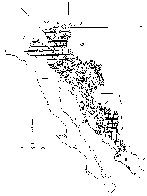 Range Map
The map shows the range area where desert tortoises live.Mojave and Sonoran desert in USA and Mexico.
Life Span
Desert tortoises have delayed maturity (14-20 years) and long life spans. Their reproduction generation cycle is 25 years, with individual shaving life spans well over 50 years. However, the desert tortoises reproductive potential is low, laying relatively few eggs (3-14) in each clutch, and having a high mortality rate for juveniles approaching 99%. Slow growth (~2.5 cm / year) and soft-flexible shells make them particularly vulnerable to predators at this stage of life.
Adaptations
Desert tortoises have unique characteristics enabling them to survive in the desert environment. Elephantine limbs and well developed claws enable tortoises to burrow into desert soils to escape the heat of the day. Burrows may be over 3 meters long with the tortoise emerging in the morning or late afternoon to forage from March - October. By November,most tortoises have begun hibernation until the following March, only emerging during winter storms to replenish water stores.
More Adaptations
Adapting to the lack of water, Tortoises have developed unique mechanisms to deal with the dry desert environment. Desert tortoises may dig shallow basins in impermeable soil to catch rainwater. However,the desert tortoise may go for many years without drinking, ingesting most of their water from plant sand then storing it in their bladders.
This was written by: Joe Watts: watts@curly.tec.army.mil last revised 8-16-96
Last up-date: January 2002
Go back to the Index.