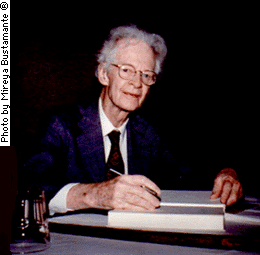
B.F. Skinner
1904-1990
"What you have done have been one of the nicest things in my life to reflect on and I thank you all." Written by B.F. Skinner to Los Horcones in a letter dated November, 20, 1989. |
"Faced with the prediction of what life will be like when critical resources are nearly exhausted and the environment irreversibly polluted, it seems irresponsible simply to teach young people to enjoy themselves in less threatening ways. But building a new culture from the very beginning may be our only hope."
B.F. Skinner, 1987, p. 12
About Los Horcones B. F. Skinner said:
"They do a wonderful job with their children. They make an effort not top punish children, and it shows, I've never seen a group of kids who so genuinely loved each other and were so cooperative with each other. Nobody is quite as systematic about it as they are. They are intelligent and dedicated..."
B. F. Skinner, The New York Times, Science section. Nov. 7, 1989
Burrhus Frederic Skinner is considered the most important psychologist of the twentieth century. He has also been the most misunderstood.
He was born on March 20, 1904 in Susquehanna, a small railroad town in Pennsylvania, U.S.A. He was the elder of two sons born to William Skinner and Madge Burrhus.
During his life, Skinner established and promoted a science of behavior which he named "Experimental Analysis of Behavior"and its philosophy Radical Behaviorism. Unfortunately, this science and philosophy have been misunderstood.
Skinner did not accept an S-R (stimulus-response) psychology because it does not explain complex behavior. A more complete explanation of behavior needs to take into account the consequences of behavior. Skinner emphasized the selective function of the consequences of the environment over the behavior (we behave as we do because of the consequences we receive by doing so).
Classical Behaviorism of John B. Watson (1878-1958) was substituted by Skinner's Radical Behaviorism.
The Experimental Analysis of Behavior gave the basis for the Applied Behavior Analysis which consisted in the application of behavior principles to the solution of personal and social problems. Los Horcones is applying behavior analysis to cultural design.
In 1931, B. F. Skinner received a Ph.D. in Psychology at Harvard University.
In 1936, he married Yvonne Blue to whom he remained married till his last day. They had two daughters: Julie and Deborah.
From 1936 to 1945 he worked at the Psychology Department of the University of Minnesota.
In 1948 he returned to Harvard University where he worked till his illness did not allowed him to continue.
B.F. Skinner died at 86 years. on August 20, 1990.
What B. F. Skinner was not.
It is very sad that most all the textbooks in psychology misrepresent B. F. Skinner. It is sad that most of the professors continue misrepresenting him.
If you are a psychology student and listen to your professor mispresenting Skinner, please give him/her our e-mail address, We can recommend him/her literature about Skinner's work that will help him/her to clarify his/her misunderstandings.
1. Skinner was not an stimulus-response psychologist. He was not based on the conditioned reflexes to explain human behavior.
2. He was not against democracy nor in favor of totalitarism. Skinner wanted a society where citizens could collectively manage their own affairs rather than depending on elites. Walden Two is a society that promotes citizen participation in the face-to-face decision-making processes. See Personocracy.
3. Skinner was not a psychologist who considered people as black boxes, this is to say, without anything inside, without thoughts and feelings.
4. He did not deny the existence of feelings. He just said feelings are products of our interaction with our environment. Skinner was concerned about feelings and thinking as well as other affective and cognitive behaviors. Feelings and thoughts are not self-initiated; something happens that makes us feel or think something. For him and all behaviorists, feelings are a product of our interaction with our environment.
5. Skinner was not an environmentalist who considered people merely as product of the environment. He, on the contrary, considered the relation behavior-environment to be bidirectional. We interact with the environment and as a result our behavior changes and we change the environment. We are not slaves of circumstances. We are not puppets nor robots.
6. He did not propose a despotic or manipulative control of human behavior. "Walden Two" the model of society proposed by Skinner is humanistic, deeply concerned in individuals as persons.
7. He did not deny human freedom and dignity. He said that the environment (social and non-social) affect us and that we also affect the environment. Skinner said that our behavior is not independent from what happens in the environment, that the behavior-environment relationship is continuous and reciprocal. In relation to dignity, he said that our personal achievements are not only products of ourselves but also from all those people who have had an influence in our life. Nobody has made his/herself alone.
B. F. Skinner was a prolific writer, he published 19 books and hundreds of articles.
Books written by B.F. Skinner:
1. The Behavior of Organisms: an experimental analysis. 1938. New York: Appleton -Century-Crofts.
2. Walden Two. 1948. New York: Macmillan.
3. Science and Human Behavior. 1953. New York: Macmillan.
4. Verbal Behavior. 1957. New York: Appleton -Century-Crofts.
5. Schedules of Reinforcement. 1957. New York: Appleton -Century-Crofts
6. Cumulative Record: a selection of Papers. 1959. New York: Appleton -Century-Crofts
7. The Analysis of Behavior (with James G. Holland). 1961. New York: McGraw-Hill.
8. The Technology of Teaching. 1968. New York: Appleton -Century-Crofts
9. Contingencies of Reinforcement: a theoretical analysis. 1969.New York: Appleton -Century-Crofts
10. Beyond Freedom and Dignity. 1971.New York: Alfred A. Knopf.
11. About Behaviorism. 1974.New York: Alfred A. Knopf.
12. Particulars of My Life (First part of his autobiography).1976. New York: Alfred A. Knopf.
13. Reflections on Behaviorism and Society. 1978. Englewood Cliffs,NJ: Prentice-Hall.
14. The Shaping of a Behaviorist (2nd part of his autobiography). 1979 .New York: Alfred A. Knopf.
15. Notebooks. 1980 .Englewood Cliffs,NJ: Prentice-Hall.
16. Enjoy Old Age (with Marguerite Vaughan). 1983. New York: W.W. Norton.
17. A Matter of Consequences (3rd and last part of his autobiography). 1983. New York: Alfred A. Knopf.
18. Upon Further Reflection. 1987. Englewood Cliffs,NJ: Prentice-Hall.
19. Recent Issues in the Analysis of Behavior. 1989. Columbus: Merrill Publishing.
Among the numerous distinctions B. F. Skinner received are:
- 1958 the Distinguished Scientific Contribution Award of the American Psychological Association.
- 1968, the National Medal of Science.
-1971, the International Award of the Joseph P. Kennedy, Jr. Foundation for Mental Retardation.
- 1972, the Humanist of the Year Award from the American Humanist Society.
- 1978, the Award for Distinguished contributions to Educational Research and Development, from the American Educational Research Association.
- 1990 , the first American Psychological Citation for Outstanding Lifetime Contribution to Psychology.
Relationship of Los Horcones with B.F. Skinner:
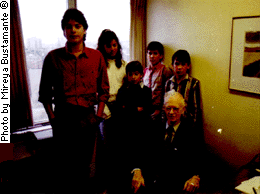
| Children from Comunidad Los Horcones visiting B. F. Skinner at his office in 1986. It was located in William James Hall, at Harvard University. Massachusetts, U.S.A. |
From the very beginning of Los Horcones, we established an epistolar relationship with Skinner which lasted until 1990, year in which he died. He wrote to the members of Los Horcones and wanted to be informed about the progress and problems of the community.
He used to write in French to one of the members about more personal matters. He talked about his feelings and explained with enthusiasm some of his experiments with pigeons.
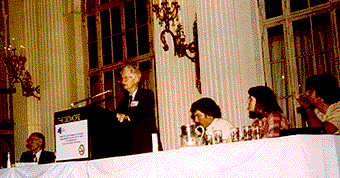 |
Members of Los Horcones on a symposium on about Walden Two along with B.F. Skinner (on the microphone) and Sidney W. Bijou (far left). Annual Convention of the American Psychological Association (APA) Los Angeles, California, 1985 |
Members of Los Horcones met with him on several occasions, usually at the annual conventions of the Association for Behavior Analysis (ABA) and the American Psychological Association (APA). We always met with him. He liked to see our children, how they behave. About them he said the following to the Arizona Republic Newspaper:
"They do a wonderful job with their children. They make an effort not top punish children, and it shows, I've never seen a group of kids who so genuinely loved each other and were so cooperative with each other. Nobody is quite as systematic about it as they are. They are intelligent and dedicated..."
He usually asked us to take him to the airport on our old and well kept WV van saying "It's like in the good old days".
We had the opportunity to record several interviews with him and a video tape about Walden Two.
We are about to publish a book of quotations about Skinner (it is written in English and Spanish). Most of these quotations related with his political, social, philosophical and humanistic ideas.
If you are interested in a copy, please write to us.
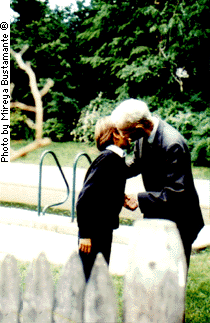
| Fred Skinner at his house in Cambridge Massachusetts, kissing good-bye Amin (one of the children from Los Horcones). |
Note.
B. F. Skinner is not a guru to Los Horcones. We are not doing what we do because we follow his ideas. A scientist is not a guru and Skinner was a scientist. A scientist contributes with data about some natural event. Skinner contributed with the concept of human behavior. Many other behavioral scientists have contributed with data. In Los Horcones we apply the data of a science to which many scientists have contributed including members of Los Horcones.
If you think that a guru is a person who teaches another, then Los Horcones has many gurus.
Last update: July, 2003
Go back to the Index.